
How to Scale a Health Coaching Business Without Burning Out
“The strongest sign of successful growth is not a busier calendar. It is a practice that can welcome its next client with the same care, preparation, and attention as its first.”
Your first few clients may fit neatly into a calendar, a notebook, and a handful of email threads. Then the referrals begin. Forms need to be sent, payments tracked, discovery calls scheduled, and follow-ups remembered. Learning how to scale a health coaching business means preparing for that growth before the work surrounding each client consumes every available hour.
A fuller practice is worth celebrating. Yet each new client can bring a second, less visible workload: another sequence of emails, documents, reminders, payments, and decisions. Soon, the Health Coach is not only serving more people. They are carrying a growing business in their head.
The solution begins by giving repeated work somewhere else to live.
What Does It Mean to Scale a Health Coaching Business?
Scaling a health coaching business means serving more people or increasing revenue without requiring an equal increase in time, effort, and administrative work.
A Health Coach who adds five clients and five more hours of weekly paperwork has grown, but the practice has not necessarily scaled. Revenue may be rising while capacity remains unchanged.

A scalable practice has a rhythm that does not need to be recreated each week. Leads receive timely communication. Clients know what happens next. Important information remains organized. Scheduling, paperwork, and reminders follow established processes.
The practice becomes easier to navigate for the client and less demanding for the person running it.
If you are exploring a future in health coaching, schedule a call with an IHPI Enrollment Advisor to learn how our certification programs can prepare you to support clients and build a practice of your own.
Signs Your Health Coaching Practice Has Outgrown Its Systems
A growing practice rarely becomes disorganized all at once. The strain usually arrives through small compromises.
A discovery call receives a late follow-up. An intake form must be re-sent. A payment requires another reminder. Sunday evening becomes the time to finish emails that did not fit into the week.
Other signs may include:
Client information is stored across several locations
Scheduling and reminders require repeated manual work
New clients receive inconsistent onboarding information
Marketing pauses whenever the client calendar becomes busy
Follow-ups depend on memory
Administrative work regularly extends into personal time
Individually, these moments may seem manageable. Together, they reveal a practice operating beyond the limits of its original setup.
Working faster may clear today’s list, but tomorrow brings another. Greater capacity comes from redesigning how work moves through the business.
The Three Systems Every Health Coach Needs to Scale
In Episode 440 of the Integrative Health Coach Success Podcast, The Only 3 Systems Every Health Coach Needs to Scale, the conversation centers on three essential areas: attracting clients, serving them consistently, and encouraging them to remain connected to the practice.

Together, these health coaching business systems create continuity across the client journey.
1. Create a Reliable Route Into the Practice
Marketing often happens in bursts when there is no repeatable way to attract and nurture leads.
A Health Coach may post regularly for two weeks, become busy with clients, and then disappear for a month. When the calendar opens again, the search for new interest resumes. The practice moves between visibility and silence based on whatever time is left after coaching.
A lead system replaces that cycle with a route someone can follow. Educational content introduces the Health Coach’s work. A clear invitation encourages the next step. Organized contact information and timely follow-up continue the conversation. A simple scheduling process makes it easy to arrange a discovery call.
That route does not need to cross every platform. It only needs to remain open when the Health Coach’s attention is elsewhere.
2. Design a Clear Client Arrival
Consider the first week of two new clients.
One receives a welcome email, payment instructions, an intake form, appointment details, and a clear explanation of how to prepare. Each step arrives when it is needed.
The other must ask where to find the form, whether the payment went through, and what will happen during the first session.
Both may eventually receive excellent coaching. Only one arrives at the first appointment without wondering whether something has been missed.
A client delivery system can organize:
Intake forms, agreements, and payments
Scheduling and appointment reminders
Welcome and preparation materials
Client notes and recommendations
Progress check-ins and follow-up
Once those details have a dependable sequence, session preparation can begin with the client’s progress instead of a search for missing paperwork. The process becomes consistent while the coaching continues to reflect the individual.
3. Give the Relationship Somewhere to Go Next
The final scheduled session is a transition point, not necessarily the end of the relationship.
Some clients may benefit from continued accountability, a maintenance option, or another program later in their wellness journey. Others may want to introduce a friend or family member to the practitioner who helped them move forward.
Progress reviews, closing conversations, post-program follow-ups, educational emails, and thoughtful referral requests create natural ways to remain connected.

This changes the shape of business development. Growth no longer depends entirely on reaching people who have never encountered the practice. It can also emerge from relationships built through months of consistent care.
What Should a Health Coach Systemize First?
When several parts of a practice need attention, rebuilding everything at once can become its own source of pressure.
Begin where friction occurs most often. For many Health Coaches, the priorities may follow this order:
Scheduling and appointment reminders
Intake forms, agreements, and payments
New-client onboarding
Session notes and follow-up
Lead organization and discovery calls
Marketing and content planning
Retention and referral communication
The first improvement does not need to transform the entire business. A booking link with automatic reminders can eliminate several weekly emails. A standard welcome sequence can prevent clients from searching for instructions. A central dashboard can replace information scattered across multiple locations.
Every new system should earn its place. If a platform introduces more steps, more maintenance, or another location to check, it may have repackaged the problem instead of solving it.
Can You Scale a Health Coaching Business Without Losing Personalization?
Yes. Personalized coaching and manually managed administration are not the same thing.
Predictable actions are usually the best candidates for automation. The practitioner’s attention remains focused where it carries the greatest value: listening closely, recognizing patterns, offering personalized wellness recommendations, and supporting meaningful change.
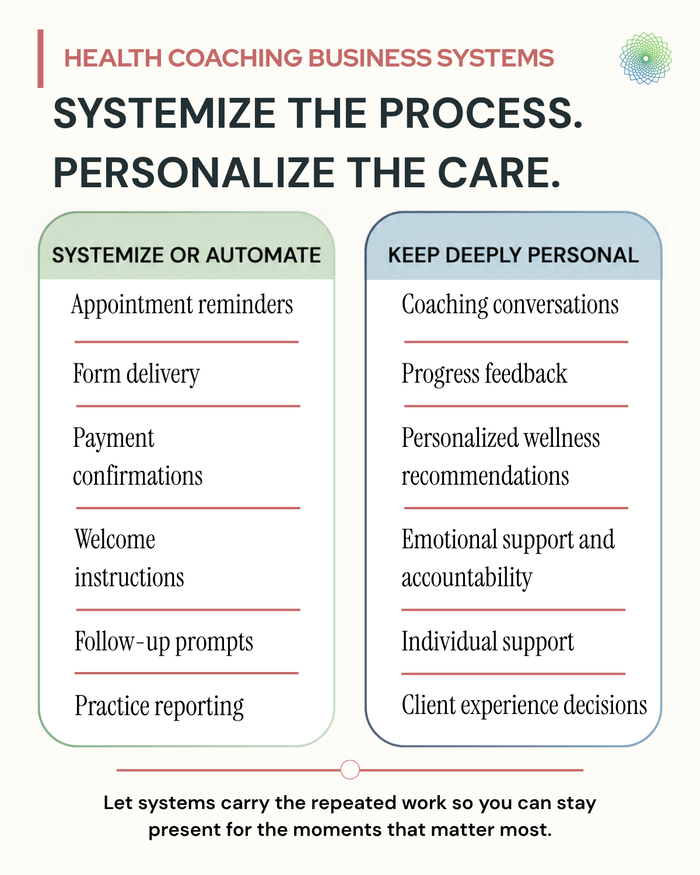
A reminder does not become more caring because it was typed from scratch for the twentieth time. Care is felt when a client arrives prepared and the Health Coach has the mental space to be fully attentive.
How Better Systems Can Reduce Health Coach Burnout
Burnout does not always begin with too many coaching sessions. It can grow in the minutes between them.
It lives in the unanswered inquiry remembered before bed, the missing form noticed during dinner, and the calendar checked on a day off. None of these tasks is especially large. Their weight comes from remaining unfinished and mentally present.

A reliable process assigns each responsibility a place, a time, and a next step. Clients understand how communication works. Availability becomes easier to protect. Administrative tasks can remain within designated working hours instead of scattering themselves across the day.
Processes can reduce mental load, but they cannot provide perspective. As a practice grows, Health Coaches also benefit from people who understand the decisions and pressures that accompany that growth.
In Episode 431, Avoid Burnout, Gain Perspective & Stay Accountable Through Shared Experience, the discussion explores how professional connection can help Health Coaches move away from isolation.
Another practitioner may have already solved the scheduling problem consuming hours each week. A trusted peer may recognize that a promising new offer demands more time than the current calendar can hold.
Systems, like PracticeBuilt, help carry the work. Community helps the Health Coach decide which work is worth carrying.
How to Scale a Health Coaching Business One Process at a Time
Choose one ordinary workweek and observe it closely.
Write down the repeated tasks involved in attracting, onboarding, serving, and following up with clients. Notice where time disappears. Record the questions clients ask more than once, the steps that frequently stall, and the responsibilities most likely to follow you beyond working hours.
Then select one process and trace it from beginning to end. A new-client onboarding process might include:
The client selects a coaching package
Payment information, the agreement, and the intake form are sent
The first appointment is scheduled
Preparation instructions and a reminder arrive
The Health Coach reviews the completed information
With the sequence visible, decide where personal attention makes a meaningful difference. The remaining steps may be handled through a template, scheduled message, or practice management platform.
Test the workflow with a small number of clients. Questions reveal where instructions need to be clearer. Delays expose missing steps. Revisions turn the first draft of a process into something the practice can rely on.
One improvement may return only a few minutes to the week. A collection of dependable processes can return hours, attention, and breathing room.
Build a Business That Can Support Its Own Growth
A Health Coach may begin with knowledge, purpose, and a sincere desire to help others. Those qualities give the practice its reason for existing. They cannot send every reminder, organize every lead, or protect every hour on the calendar.
Learning how to scale a health coaching business means building an operating structure equal to that purpose. Leads can move forward without being forgotten. Clients can receive a consistent experience without losing individualized support. The Health Coach can finish the workday without mentally taking the entire practice home.

A trusted professional community adds another layer of support when growth brings unfamiliar decisions.
The strongest sign of successful growth is not simply a busier calendar. It is a practice that can welcome its next client with the same care, preparation, and attention as its first.
Ready to continue building your practice? Read Health Coaching Clients: 10 Steps to Attract Your First 10 for practical ways to reach and connect with the people you are meant to serve.